Hang Me Up to Dry
Nathan Willett wrote "Hang Me Up to Dry" about baptism, and it sounds like it.
Nathan Willett wrote “Hang Me Up to Dry” about baptism, and it sounds like it.
Not the gentle kind — not the white dress and the quiet river and the congregation watching from the bank. The kind where something in you goes under and comes up changed, and you’re not sure yet if the change is good, and you’re wringing out the person you used to be and hanging it somewhere to figure out what’s left.
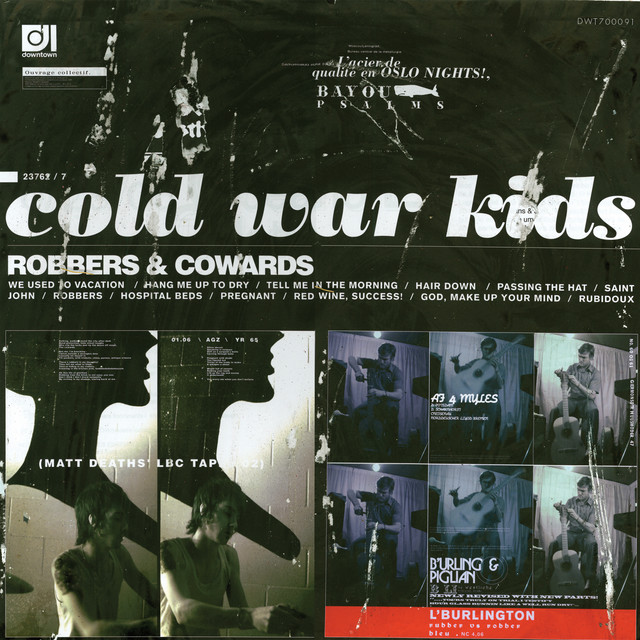
Cold War Kids formed in Long Beach and cut Robbers & Cowards on Monarchy Music, a record that sounds like it was made in a room with bad lighting and good instincts. Matthew Schwartz produced it, and the whole thing has a rawness that wasn’t an accident — the band tracked live whenever they could, kept the bleed, kept the room. You can hear the piano and the drums arguing with each other the way they do when musicians are playing in the same space and nobody’s been isolated into their own little box. That argument is the sound of the record.
“Hang Me Up to Dry” is built on a piano figure that doesn’t resolve so much as it insists. It circles. It pushes. And Willett’s voice sits on top of it like a man who has already said too much and is going to say the rest anyway.
The lyric that gets me is early: “dirty, dirty feet from the concert and the fair / and I just don’t care.”
That’s not a line you draft in a notebook and polish. That’s a line you write when you’ve been somewhere and come home and looked down and decided the cleaning can wait, because the dirt is proof of something. There’s exhaustion in it. There’s also a specific kind of peace that comes right before the reckoning. He’s not there yet. He still doesn’t care. And then the song starts turning the screw.
Because baptism — real baptism, the kind Willett grew up inside as an evangelical Christian in Southern California — is about exactly that turn. You go under carrying everything you are. You come up and someone tells you you’re new. And you stand there dripping, trying to figure out what to do with the person you were two seconds ago.
“You washed your hands but you still see the evidence of a struggle.”
That’s the whole tension of the song in one line. The ritual worked and it didn’t. The evidence is still there. Hang it up, let it dry, see what shape it holds when the water’s gone.
Willett was twenty-four when the record came out. He’d been carrying these questions around long enough that they weren’t theoretical anymore — they had weight, they had texture, they had the kind of physical specificity that shows up in that line about feet. The band played whatever they could get: churches, backyards, college venues, anywhere that would take them. By the time they tracked this record, they’d road-tested these songs enough to know where the load-bearing walls were. This one holds itself up with that piano and with Willett’s refusal to let the song be comfortable.
Matthew Santos has a moment in the song — not as a credited collaborator, but the band’s particular arrangement of voices, the way the harmonies pile up and then thin out, owes something to the live-room ethic the whole record was built on. Drummer Matt Aveiro and bassist Jonathan Russell lock into a groove that is simultaneously spare and urgent. There is space in this song, intentional space, and the space is where the doubt lives.
The song got placed on Grey’s Anatomy in 2007 and introduced a lot of people to a record that deserved to be heard. That’s not a criticism — the placement worked because the song was already doing what good television music does: it was sitting inside a feeling that couldn’t quite be named. Whatever room you were in when you first heard it, the song arrived knowing something about the room.
But the thing that has kept it around isn’t the placement, isn’t the indie rock credibility of the moment, isn’t any of the circumstantial stuff. It’s that the central image — the wrung-out thing, the hanging-up, the question of what survives the washing — is one of the oldest questions a person can ask themselves, and Willett asked it at full volume with his whole chest, over a piano that refused to let him off the hook.
He didn’t resolve the question in the song. The song ends before the thing dries. You don’t get to see what shape it holds.
That’s not an omission. That’s the point. You hang the thing up and you walk away and you wait, and you find out what’s left when you come back. The song just has the honesty to stop there — at the hanging, at the waiting — and trust that you know what comes next, because you’ve been through your own version of the water, and you’re still figuring out who came out the other side.