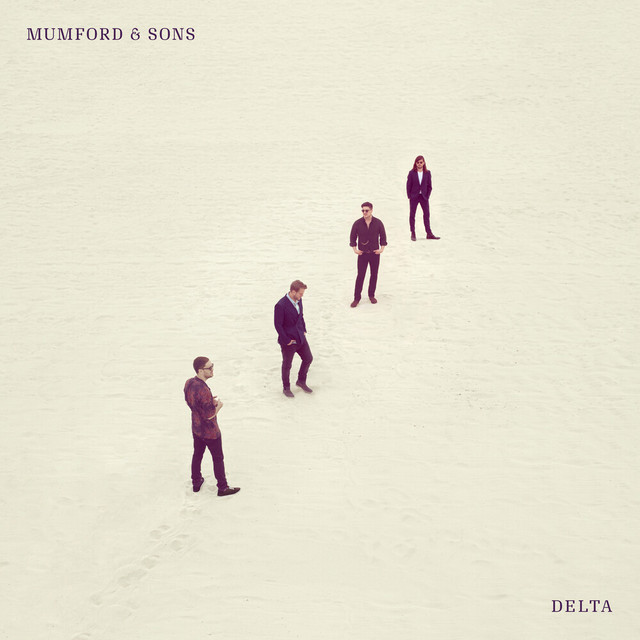
Delta
Marcus Mumford wrote "Delta" at the end of a marriage that almost didn't survive.
Deep in the final third of the song, a second voice comes in underneath Marcus Mumford’s. It doesn’t sing a lead line. It doesn’t take the song away from him. It just holds the weight alongside him, low enough that you could miss it entirely if you weren’t listening for it. The voice belongs to his wife, Carey Mulligan — and “Delta” is the song Mumford wrote at the end of a marriage that almost didn’t survive.
The song is six minutes and sixteen seconds long, which is a statement in itself — a deliberate refusal to make things easy, to wrap up the damage in radio time. It opens with a guitar figure so sparse it sounds like the space between words when you don’t know what to say anymore. It builds and builds, and then it breaks, and then it builds again. That structure is not an accident. It’s the shape of what it describes.
The album Delta came out in 2018, five years after the band had nearly dissolved into the fallout from Babel — the Grammy wins, the stadium tours, the backlash that followed any artist who gets too big too fast. Ben Lovett, Winston Marshall, Ted Dwane and Mumford had scattered. They lost a manager, rethought the whole enterprise, made a record without banjos called Wilder Mind that half their audience didn’t follow them into. By the time Delta was being assembled, they were making music with something to prove only to themselves.
Paul Epworth produced it — the same man behind Adele’s 21, behind Florence and the Machine’s most cathedral-sounding moments. He understood how to make a room feel enormous without letting it go empty. And on “Delta” especially, that understanding earns its keep. The production doesn’t decorate. It presses.
The word itself does the first work. A delta — the Greek letter, the geographical fact — is a place where something moving meets something still. A river runs its entire length and then fans out at the end, diffusing into the water it’s been heading toward all along. Mumford uses the word to talk about a marriage, about what happens when two people who chose each other stand at the place where the choosing gets tested by actual living, actual failing, actual staying anyway.
“In the nature of this existence, I will love you ‘til the stars fall from above.”
That line lands harder in context than it looks on paper. Because it’s not the triumphant vow it sounds like from the outside. It’s the vow made by someone who has already seen the stars wobble. Who knows the distance between the promise and the keeping of it. The word nature is doing something quiet there — he’s not saying despite the nature of existence. He’s saying in it. Inside it. Whatever the conditions are, this is what’s true.
Mulligan, the actress, married him in 2012, was still with him when this record came out, and is with him still. That she’s in the song at all — underneath it, never out front — seems right.
There’s a thing that happens when a song runs past five minutes — the listener’s trust gets transferred. The first four minutes you’re still in a transaction, giving your attention and waiting to see if it’s worth it. After five minutes, if the song has kept you, something shifts. You’ve stopped deciding whether to stay. You’re just in it now, wherever it’s going.
“Delta” earns those last two minutes. The arrangement opens up into something close to overwhelming — drums, strings, the full band playing like they’ve been told this is the last take. But the lyric underneath all of it stays plain. He’s not reaching for poetry at the peak. He’s just saying what he means as clearly as he knows how.
That’s the hardest thing to do at full volume. Most songs that go big go vague — the emotion gets turned up but the specificity gets lost, replaced by whatever phrase sounds like it means everything. Mumford stays specific. The song stays about one man and one woman and the actual years they lived through together. The grandeur is in the sound, not in the abstraction.
The album closer doing the work that the album title promises — resolving the whole record’s themes in its final moments — is a structural gamble. It requires that everything before it have been building toward something the listener doesn’t fully see until the last song names it. Delta the record is full of estrangement and reunion, distance and return, the geography of two people’s inner lives and the long walk back to one another. The song earns the title.
He never lets it become a victory lap. The song doesn’t end with reconciliation triumphant. It ends with something quieter — with the ongoing fact of the choice, renewed but not resolved, which is what a marriage actually is. Not a destination. A delta. A place where the moving meets the still, where what’s been rushing forward finally spreads out, and stays.