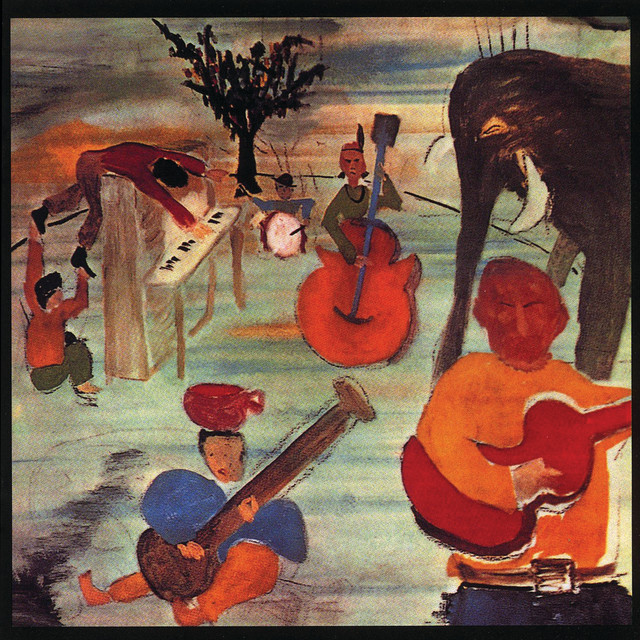
The Weight
*Take a load off, Fanny.* The name isn't Fanny.
Take a load off, Fanny.
The name isn’t Fanny. There is no Fanny. There’s no single person behind the name — there’s a rooming house in Nazareth, Pennsylvania, a journey nobody asked for, and a list of people Miss Moses, the devil, Chester, and Luke each offering the narrator some piece of the load he’s carrying, none of them able to take it. The song ends without resolution. He never puts the weight down.
That ambiguity was the whole argument.
Robbie Robertson wrote “The Weight” in 1967 trying to figure out what Luis Buñuel and Federico Fellini were doing in their films — that specific feeling of a man who arrives somewhere with good intentions and finds himself surrounded by forces larger than he is, pulled in every direction, nobody quite helping, nobody quite hostile. He was in his early twenties. He was reading Buñuel, listening to Americana, and trying to write a song that felt like walking into a strange town in a movie that didn’t care whether you understood it.
He put it on Music from Big Pink, the first record The Band made together in Woodstock, New York, named after the pink house they rented from Albert Grossman. They recorded it in the basement with Bob Dylan, who was recovering from a motorcycle accident and had stopped touring and was writing the Basement Tapes in the same rooms. The air in that house was full of old hymns and railroad songs and Carter Family records — the whole weight of American music pressing down on a bunch of Canadian guys from the Hawks who had spent years as a hard-touring backup band and were now trying to figure out what they sounded like on their own.
They sounded like this.
What Robertson figured out — and what most rock bands in 1968 had no interest in figuring out — was that the song didn’t need a hero. The narrator isn’t wise. He’s not even particularly sympathetic. He just keeps arriving at places and meeting people and finding that nobody can give him what he needs, and he keeps trying anyway. Levon Helm sang the first and last verse, and the other guys rotated through the middle, and that shared voice — no single lead, the weight passing between them — is part of what the song is about.
It is the rare song where the arrangement is the argument.
The drum sound Helm got on this record was something people spent years trying to recreate. He played like a man who grew up in the Arkansas cotton fields, which he did — Helena, Arkansas, the son of a cotton farmer, who fell in love with rock and roll when he was a boy and Sonny Boy Williamson came through on his radio show. Helm didn’t hit the drums like a session player marking time. He hit them like someone who had work to do. And on “The Weight,” where the whole thing is about effort — about the effort of carrying, of helping, of showing up and still not being enough — his playing is both the labor and the relief.
I pulled into Nazareth, was feeling ‘bout half past dead.
Nobody knows exactly why Nazareth, Pennsylvania. Robertson said he picked it because of the Martin Guitar factory there — Martin had been making instruments in Nazareth since 1839, the guitars that country and folk musicians played, the whole physical lineage of American acoustic music rooted in that town. Whether that’s the whole story or the story he settled on later, it doesn’t matter much. The town earned its place in the song. It sounds like a place where a man would arrive exhausted and find no easy comfort.
The record came out in 1968. It was reviewed well. It did not chart particularly high. But it landed in the hands of musicians who played it until it fell apart and then went out and built careers trying to understand what they’d heard. Gregg Allman said it changed what he thought a band could be. It showed up on every list of influential records that followed, not because people were told it was important, but because players kept going back to it.
The Weight Watchers and the Weight-lifters and everyone who has ever been handed someone else’s burden knows what the song is doing. Not asking for credit. Not offering solutions. Just describing the condition — the way life keeps arriving with requests, the way every Fanny and Chester and Luke has something they need from you, the way you put it down in one place and pick it up in another.
And we’ll take a load off, and you put the load right on me.
You put it right on me. They’re not saving each other. They’re just passing it around. That might be as close as the song gets to hope — not that the weight disappears, but that you don’t have to carry it alone every minute. Someone else can hold it while you rest.
Robertson was twenty-four when he wrote it. He had been on the road since he was sixteen, carrying equipment and learning stages and doing what you do when music is the only life that makes sense. He knew what a load felt like. He just never pretended he knew how to put it down for good.
Neither does the song. And that’s exactly why it has lasted.