Back in Black
Brian Johnson had never recorded a lead vocal for a major album.
Brian Johnson had never recorded a lead vocal for a major album. He’d been fronting a pub band called Geordie for years, scraping by, and by 1979 he was working in a windshield wiper factory in Newcastle when AC/DC called.
The band had just lost Bon Scott. Scott died in February 1980 — thirty-three years old, found in the back of a friend’s car in London, dead from what the coroner listed as acute alcohol poisoning. He had been the voice, the swagger, the architect of everything AC/DC was on stage. Nobody expected the band to survive it.
They had two weeks of material ready for what was supposed to be Bon Scott’s next record. They hired Johnson instead of shelving the songs, and they went to Compass Point Studios in Nassau, Bahamas, in April 1980 — barely two months after the funeral — and they made Back in Black.
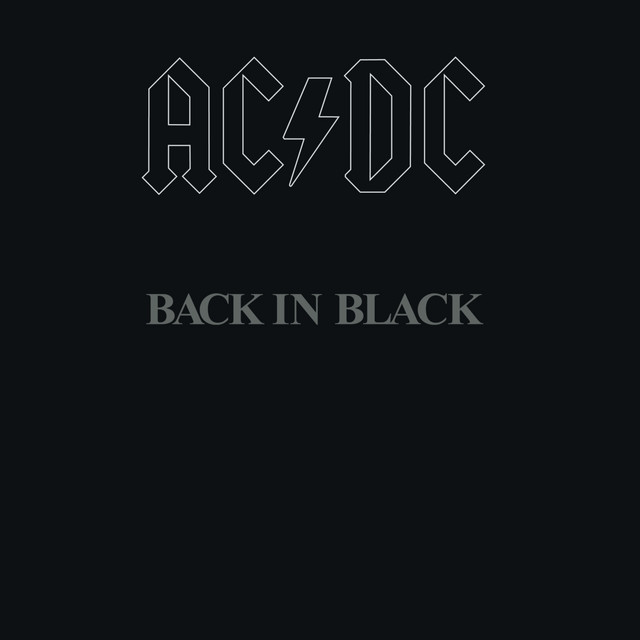
The album opens without Johnson. It opens without guitars, without drums, without any of the band at all. It opens with a bell. Thirteen strokes of the Denner Bell, which the producers Robert John “Mutt” Lange and the band recorded specifically to toll for Scott — thirteen notes of pure weight before a single chord is struck. They named the album Back in Black as a kind of mourning dress. The AC/DC lightning bolt stayed, but everything else on the cover is black. The whole thing is a tribute that doesn’t say the word tribute once.
And then the riff starts.
Malcolm Young’s rhythm guitar drops in and the whole world rearranges itself. That opening riff to the title track is one of the cleanest pieces of architecture in rock — four notes building a phrase, the phrase dropping away, then the drums hammering down underneath it like a door being kicked in. Malcolm played it. It is almost always credited as Malcolm’s creation, Angus the soloist and showman, Malcolm the one who held the room together. He played it on a battered ‘63 Gretsch Jet Firebird through a studio monitor turned to face the wall, and it sounds like a freight train that knows exactly where it’s going.
Then Johnson opens his mouth and the bet pays off completely.
He doesn’t mourn on this record. That’s the thing. He walks in like he owns the room — “back in the back of a Cadillac,” rolling, double-tracking his own voice, that shriek flying up over the guitars like he’s been doing this for thirty years. Which he hadn’t. He had been fixing windshield wipers. He had exactly one shot, and he took it with both hands.
“Forget the hearse ‘cause I’ll never die.”
In any other context, that’s a boast. Here it’s something stranger. Johnson singing that line on a record made two months after Bon Scott’s death, on an album that opens with thirteen tolling bells — it becomes something the band probably couldn’t have planned. A rebuke and a promise at the same time. The band isn’t pretending Scott didn’t happen. The bells already said he did. But they’re not going to be a museum, either.
Mutt Lange recorded it live at Compass Point with minimal overdubs, and you can hear it — the room is in the record. The drums breathe. Phil Rudd’s kick and snare are so dry and close they sound like they’re happening inside your chest. Cliff Williams on bass sits so low in the mix he’s almost felt rather than heard, but pull him out and the whole thing falls apart; he’s the foundation everyone else is building on.
The production philosophy was old-fashioned in 1980 and intentional. Lange had just finished massive commercial records that leaned on gloss. Back in Black was stripped. Every instrument in its lane. No reverb piled on to make the empty spaces feel full. The empty spaces are supposed to feel empty — that’s where Rudd lives, in the space between the beats, and it’s where the song gets its weight.
Fifty million copies. Probably more by now. The second-best-selling album in history by most counts, behind only Thriller. But chart positions don’t tell you what the record actually did, which was keep a band alive when nobody expected them to survive and make grief into velocity.
Johnson stuck around for thirty-five years after this, until hearing loss finally forced him off the road in 2016. He came back in 2020. Malcolm Young died in 2017, the Gretsch Jet Firebird long retired by then, his memory already gone from dementia for years before his body followed.
But the tape doesn’t know any of that. The tape just has four notes, then the riff, then a man from Newcastle stepping up to a microphone in the Bahamas in the spring of 1980 with everything to prove and nothing left to lose.
Back in the back of a Cadillac.
He drove it like he’d built it himself.