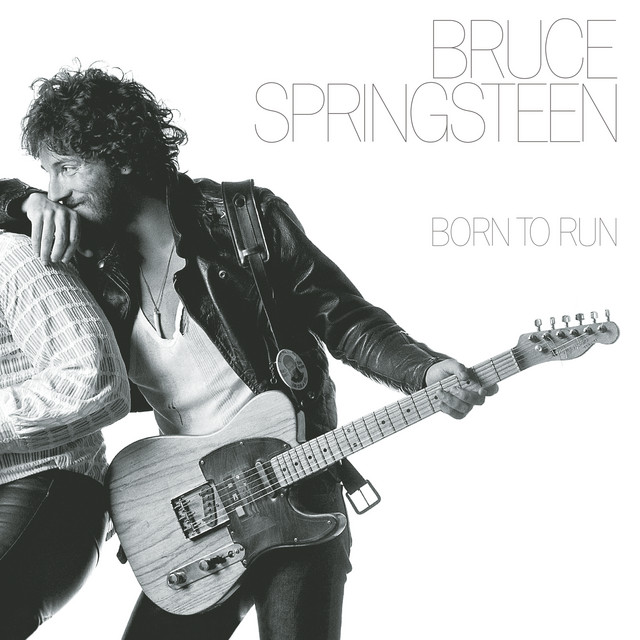
Thunder Road
Mary's dress waves like a vision of somebody Springsteen hadn't yet become.
Mary’s dress waves like a vision of somebody Springsteen hadn’t yet become.
That detail matters because “Thunder Road” is the first track on Born to Run, and Bruce Springsteen wrote it knowing exactly what he was betting. Columbia Records had given him two albums and watched both of them quietly fail to find an audience. The third album was supposed to be the one that justified the contract, the band, the mythology that Jon Landau had already started building in print when he wrote “I have seen the future of rock and roll” — a line that must have felt like a stone tied to Springsteen’s neck as much as a crown. He had everything to prove and no guarantee he could prove it, and he chose to open the record not with a roar but with a screen door slamming.
“The screen door slams, Mary’s dress waves.”
Those are the first two lines of the album. Not the first two lines of the song — the first two lines the whole record makes. And they are so specific and so plainly American that they do in eight words what a lesser songwriter would need a verse and a chorus to attempt. You are already standing on that porch. You can feel the heat.
The song was recorded at 914 Sound Studios in Blauvelt, New York, with Roy Bittan’s piano and Danny Federici’s glockenspiel doing most of the early heavy lifting — an unusual choice, that glockenspiel, that delicate metallic chime running under a song about a beat-up town and a kid trying to talk a girl into leaving it with him. But it works because the song is not really a song about escaping. It’s a song about the moment before you decide whether to try. The glockenspiel sounds like something fragile. Like hope before it’s been tested.
Clarence Clemons’ saxophone doesn’t come in until well past the two-minute mark, and when it does, something shifts. It stops being a bedroom song and becomes a highway song. The sax is the open road given a sound. Springsteen knew what he had in Clemons — he’s talked about the night Clarence walked into a bar where the E Street Band was playing and blew the door practically off its hinges. The two of them built a musical friendship that looked, from the outside, like a conversation between equals who happened to need exactly what the other one had.
The song is a plea. That’s the thing people sometimes miss inside all that grandeur. The narrator is not certain. He’s not offering Mary a life — he’s asking her to take a chance on the same incomplete future he’s got. “I got this guitar and I’ve learned how to make it talk.” That’s the resume. A guitar and some nerve. He’s selling her on the idea that the trying is enough, that the road itself is the point, that what they’d be leaving is smaller than what they’re moving toward even though he can’t describe what they’re moving toward in any concrete terms.
“It’s a town full of losers and I’m pulling out of here to win.”
That last line gets quoted as triumph. It plays as triumph. But read it standing still: he doesn’t say he has won. He doesn’t say he will win. He says he’s pulling out to try — and the town full of losers includes him, past tense, and maybe the whole notion of winning is the story he’s telling himself to make the leaving feel like the right thing. Springsteen wrote narrators like that throughout his career — men who are partly fooling themselves, and know it, and go anyway.
The album took six months longer than it should have and nearly bankrupted everyone involved. Springsteen was obsessive about the production — he and Landau, who had come on as a creative partner by that point, fought over the sound in ways that wore out the patience of everyone else in the room. Phil Spector’s Wall of Sound was in Springsteen’s head; he wanted Born to Run to feel enormous, to feel like weather, to feel like the kind of music that gets into your chest. The mixing alone ran for weeks.
You hear all of that work in “Thunder Road.” Not because it sounds labored — it doesn’t, it sounds inevitable — but because the production has that careful wildness to it, everything controlled just enough to seem out of control. The piano and the glockenspiel and the harmonica and then the guitar and then Clarence, all of it building the way a storm builds when the pressure has been climbing all day and you can feel it coming even before you see the clouds.
Springsteen was twenty-five when Born to Run came out. He has been living inside these songs ever since — still plays “Thunder Road” live, still opens sets with it sometimes, and by now he’s been doing it for fifty years. At some point a song stops being something you wrote and becomes something you are. He wrote a young man’s dare to a girl on a porch in a dying town, and it turned out to be the dare he was making to himself: get in the car. See what you’re made of. Go.
Mary hesitates in the song. She stands on the porch with her dress waving, and the narrator has to talk her all the way through four minutes and forty-nine seconds of hesitation before she finally gets in. We never hear her say yes. We just hear the song end with the road ahead, and the assumption that she came.
That’s the whole argument, made in a single deliberate absence. He didn’t write her refusal, and he didn’t write her certainty. He wrote the moment of choosing, and then he left it open, because every person who has ever stood at a threshold and wondered whether to go recognizes that feeling — and filling in what happens next is your job, not his.
Fifty years on, he still opens sets with it sometimes, and the song still starts where it has always started:
“The screen door slams, Mary’s dress waves.”