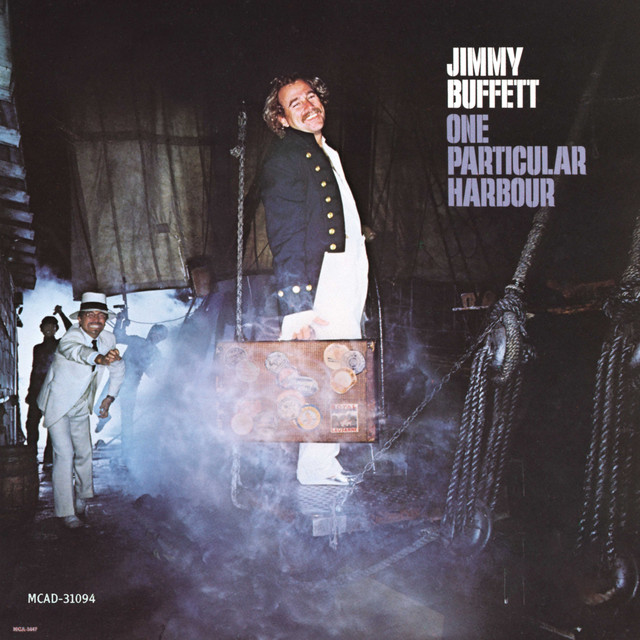
One Particular Harbour
The song came out on *One Particular Harbour* in 1983, but Buffett had been circling the idea for years before he wrote it down — that there is a place you carry inside yourself th
The song came out on One Particular Harbour in 1983, but Buffett had been circling the idea for years before he wrote it down — that there is a place you carry inside yourself that no real harbor can fully match, and the whole project of a life is the search for the version that comes closest.
That’s a lot to put in a song. He pulls it off.
The album version runs nearly six minutes, and it earns every one of them. There’s no hurry in it. The production is warm and patient — Roger Guth on drums keeping a loose, unhurried beat, the guitars sitting back in the mix the way a good porch sits back from the road. Buffett had been recording in Muscle Shoals and working with producers who understood space, and you can hear it here: the arrangement doesn’t push. It waits. It lets the song be the kind of song it’s describing.
What Buffett is doing lyrically is something closer to philosophy than storytelling, which is unusual for him — he was almost always a storyteller first. But here he isn’t giving you a character or a narrative arc. He’s giving you a condition of being human.
“I know I don’t get there often enough, but God knows I surely try.”
That line is doing a lot of work quietly. It’s not resignation. It’s not self-pity. It’s just an honest accounting of the distance between the life you’re living and the life you can feel waiting for you somewhere — the gap between the harbor you’ve found and the one particular harbor you’re still looking for. Most people feel that gap. Most songs pretend it doesn’t exist, or promise you it can be closed if you buy the right product or fall in the right love or move to the right city. Buffett doesn’t pretend. He just names the gap and stands in it.
“It’s somewhere I have felt before, and I know it’s waiting out there for me.”
There’s a kind of faith in that — not religious faith, exactly, but the faith that the feeling is a signal pointing at something real. That the yearning is evidence, not just longing. He’d been sailing the Caribbean long enough by 1983 to know that no specific place stays perfect, that the harbor you thought was it becomes ordinary once you’ve anchored there enough times. The paradise that holds is the one you can’t quite reach.
Buffett came to this idea honestly. He’d built a career on the romance of place — Key West, the Yucatan Channel, Havana, the waters off Belize — and he understood better than almost anyone the disappointment that follows arrival. The Margaritaville brand was still being assembled in 1983, the merchandise and the theme restaurants still years away, but the philosophical tension at the center of that whole empire was already present in this song: you can sell the beach, but you can’t sell the particular feeling of the beach you haven’t been to yet. The longing is the product. And here, in this six-minute song buried in a box set that most people know from compilations, he’s staring directly at that tension and telling the truth about it.
He never pretended the paradise was real. He just kept going back to find it anyway. That’s not delusion. That’s the human thing. The trip and the knowledge that the trip won’t complete itself and the decision to take it anyway — all three at once.
The song ends with a repeated return to the chorus, the band loosening, the whole thing unwinding like a tide going out. No big finish. No key change to signal importance. Just the song settling into the water it’s been describing for six minutes. The one particular harbor is still out there at the close. He hasn’t reached it. He isn’t going to reach it.
But he knows it’s waiting.
That knowledge — not arrival, just the certainty of the direction — turns out to be enough to keep moving. It’s the only kind of enough there is for people who keep sailing past the good-enough harbors because they can feel the right one somewhere past the horizon.
Buffett died in September 2023. He’d been sailing toward that harbor his whole life, and he never stopped pointing the bow.