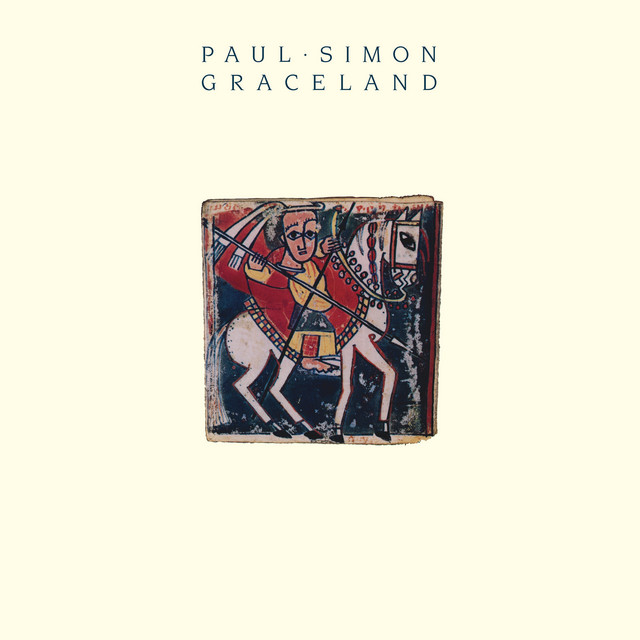
Graceland
Paul Simon took a cassette tape home to New York in 1984 and spent a year trying to figure out what to do with the music on it.
Paul Simon took a cassette tape home to New York in 1984 and spent a year trying to figure out what to do with the music on it.
The tape was a compilation of South African township music — mbaqanga, mostly — passed to him by a friend. Simon had been through the roughest stretch of his career: Hearts and Bones, the album he poured everything into, had sold almost nothing. He was fifty credits into a twenty-year run and suddenly invisible. He put the tape in his car deck and drove around Manhattan listening to it until something cracked open in him, some recognition he couldn’t name. Then he got on a plane to Johannesburg.
What came back with him was a rhythm section that barely needed him — Baghiti Khumalo on bass, Isaac Mtshali on drums, the accordion player Forere Motloheloa working the groove from underneath like the floor of the song was already complete before Simon arrived. The title track, “Graceland,” was built on that foundation, and what Simon brought to it was something stranger than a melody: he brought a road trip, a divorce, a dead marriage carried through the American south like luggage he couldn’t put down.
The song begins in Mississippi, heading west on Highway 61, and from the first line it’s tracking two things simultaneously — the physical journey toward Memphis and the interior landscape of a man who has lost something big and hasn’t quite admitted it yet.
“The Mississippi Delta was shining like a national guitar.”
That line has been quoted so many times it’s easy to miss how precise it is. Not a National Guitar — a national guitar, lowercase, the resonator’s metallic gleam in flat summer heat, the way the whole delta sits low and bright and burnished. It’s a visual observation that doubles as a statement about the music underneath the song: slide guitar, country blues, the root system of American sound. Simon is traveling toward his own mythology and calling it by its real name.
His son is in the car with him. The marriage that’s ending goes unnamed; there’s just the boy, and the road, and the two of them heading for the mansion on the hill where Elvis is buried in the garden.
That’s the whole architecture. A man with a hole in his life, driving toward a monument to somebody else’s life and death, looking for something he can’t articulate because grief doesn’t come with a map. He says it plainly: “I have reason to believe we all will be received in Graceland.” Not that he deserves it. Not that he’s earned it. Just that he believes it, in the desperate open-handed way people believe things when the alternative is too heavy to carry.
The session players from Johannesburg are why this works the way it works. Simon has always been a craftsman of the top line — the melody, the syllable, the way a vowel lands — but on this track the rhythm section is doing something below the lyric that the lyric can’t do alone. The bass moves in that rolling, lateral way mbaqanga bass moves, like it’s tracing the edge of something instead of marking the center. The guitar parts, played by Ray Phiri, are light and conversational where American rock guitar would be declarative. The whole arrangement breathes. It makes room.
That breathing is what lets the sadness in without announcing it. Simon doesn’t write a breakup song here. He writes a road song, and the breakup lives in the negative space — in the fact that there are only two people in the car and one of them is a child, in the fact that he’s going somewhere no living person can actually reach, in the fact that “she comes back to tell me she’s gone” is a line that only makes sense if you’ve been through exactly that kind of ending, the one where the goodbye keeps happening after the person is already gone.
The anti-apartheid movement raised real objections when Simon brought South African musicians to this record without explicit political framing. The criticism mattered and Simon took it seriously, though he also held his position — he wasn’t making a statement, he was making music with people who moved him, and he paid them fairly and credited them fully at a time when that wasn’t guaranteed. The argument is still worth having. But the music went where it went: Ladysmith Black Mambazo’s appearance on the album opened a door for Joseph Shabalala’s group that turned into a whole second career internationally, and “Graceland” the song carried the sound of Johannesburg into rooms that had never heard it.
That’s not absolution. It’s just what happened.
Elvis Presley had been dead seven years when Simon wrote this. Graceland the house was already a pilgrimage site, a place where people went to stand near the shape of a life they felt some claim on. Simon isn’t satirizing that impulse. He’s inside it. He doesn’t visit the mansion because Elvis meant everything to him — he visits because it’s the kind of place you go when you need to believe in something, and he needed to believe in something.
The boy in the car is Harper Simon. He was eleven or twelve. He grows up to be a musician. He never appears in the lyric as anything more than a presence — Simon’s traveling companion, his reminder that there’s still something tethering him to the world — but the whole journey is partly for him, the way all the things fathers do when they’re coming apart are partly for their kids and partly just the only thing left to hold onto.
The song ends without arriving anywhere definitive. Graceland is ahead on the road. Whether they get there, whether it helps, whether the hole closes — none of that is in the lyric. Just the belief, stated plainly and left there.
We all will be received in Graceland.
He’s still out there on the road when the song fades, short of Memphis, still believing it.