She Talks to Angels
She never told the family where she was going.
She never told the family where she was going. That’s the detail that cuts deepest in this song — not the needle, not the roses, not the cross around her neck. The fact that there are people in a house somewhere who stopped knowing her a long time before she was gone.
Chris Robinson wrote “She Talks to Angels” about a real woman. He watched her. He paid attention in the particular way that young writers do when they’re still close enough to the ground to notice the people everyone else has decided not to see. He was twenty years old.
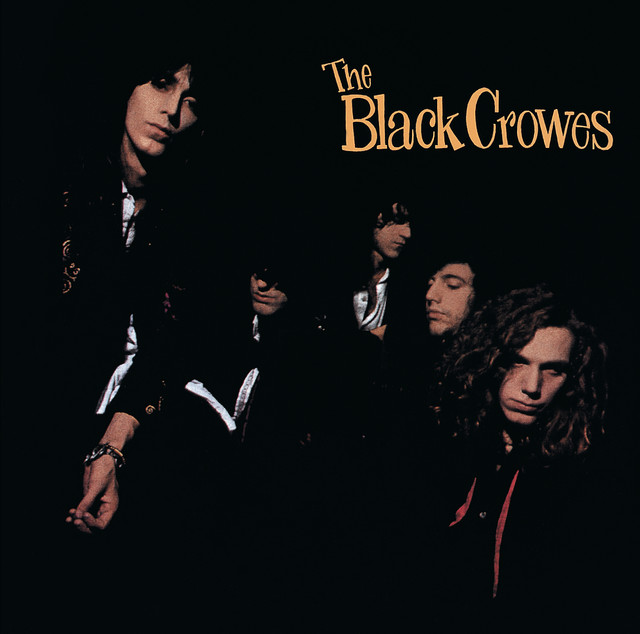
The song came out of Atlanta, 1990, when the Black Crowes were still the Mr. Crowe’s Garden that nobody outside Georgia had heard of. Shake Your Money Maker was their debut, produced by George Drakoulias on a budget that kept things lean — and the leanness is in every note of this track. Rich Robinson plays the acoustic guitar part alone, and the part is the whole architecture. No drums to hide behind. No rhythm section carrying the weight. Just the open-tuned guitar, and the voice, and the story.
It’s a five-and-a-half minute song that doesn’t feel long because it doesn’t waste a second. Every verse adds one more brushstroke to the portrait: the painted smile, the scarlet rose tucked in her hair, the cross hanging from a rearview mirror like a prayer she hasn’t given up on completely. Robinson stacks the details the way you’d describe a person to someone who’d never seen them — specific, patient, not trying to explain what he can’t explain.
She talks to angels, says they call her out by her name.
The title is the most generous interpretation Robinson could have offered. He could have called her an addict. He could have written a song about waste or tragedy or the failure of systems. He called her a woman the angels know by name. That choice is doing everything. It doesn’t pretend the needle isn’t real. It holds the needle and the angels at the same time, because that’s what he saw — a person who had not been reduced to her worst moments, who was still, somehow, reaching toward something.
The cross around her neck isn’t irony. This song has no irony in it. The cross is the same cross it is for anyone who wears one: a gesture toward the possibility of grace, hanging on even when the life it hangs against has gotten very hard to live. Robinson doesn’t smirk at that. He notes it the way you’d note the color of someone’s eyes.
Drakoulias knew enough not to crowd the production. The full band enters gradually — Marc Ford on electric guitar, Johnny Colt on bass, Steve Gorman on drums — but even when the track fills out, there’s space in it. The song breathes. It has to breathe, because the subject requires it. Crowd a portrait and you lose the face.
Robinson’s voice in 1990 was already something that didn’t belong to its era. It’s worn at the edges in a way that twenty-year-olds’ voices generally aren’t. He sounds like someone who has been paying attention to old records and older grief for a long time, and who has also maybe seen some things himself. You believe him when he sings it. That’s not a small thing. A story like this can collapse into condescension in the wrong hands — the outside observer explaining the fallen woman, cataloging her ruin. Robinson never stands outside her. He stands next to her, watching the same distance she watches.
The song was the album’s second single, and it was the one that made people stop and look back at the rest of the record differently. Not because it crossed over or climbed charts — it did fine — but because it was the one that revealed what the band was actually capable of beneath the Faces covers and the Stones swagger. This was the song that said they had their own thing.
The woman in the song never told the family where she was going. That line lands differently the longer you sit with it, because it isn’t just about geography. She went somewhere the people who loved her couldn’t follow, and she went slowly enough that they would have had chances to watch her leave, if they’d known how to look. Maybe they looked and didn’t know what they were seeing. Maybe she looked back.
Robinson wrote her down so she wouldn’t disappear entirely — five and a half minutes, no chorus, no resolution, no lesson about what it all means, just the painted smile and the scarlet rose and the cross she hasn’t let go of, one patient detail after another, until a woman who never told her family where she was going is still arriving, verse by verse, in every room where somebody plays this song.