Copperhead Road
There's a real road.
There’s a real road.
It runs through Johnson County, Tennessee — a two-lane cut through the mountains outside Kingsport — and the people who lived on it knew what the name meant before Steve Earle ever touched a guitar. Copperhead Road was where you didn’t go unless you belonged there, and if you belonged there, you already understood the terms.
Earle grew up close enough to that world to see it clearly. Not from inside it, but near enough to know its logic — the way certain families pass down certain trades the way other families pass down property, or faith, or silence. When he sat down to write the song, he wasn’t inventing a mythology. He was reporting on one that already existed, had existed for generations, and didn’t much care whether anyone in Nashville thought it was appropriate subject matter.
The song runs three verses, and it is essentially a family saga compressed to four minutes and twenty-nine seconds. The grandfather runs moonshine on the road. The narrator’s father runs moonshine on the road. The narrator comes back from Vietnam — two tours, which is the detail that lands hardest, because one tour you might survive intact — and applies everything the Army taught him to growing marijuana in the same hills, for the same reasons, against the same set of people who will eventually come looking.
Well I learned a thing or two from Charlie don’t you know.
That line is doing something ruthless. It takes the education the government gave him — how to move through territory without being seen, how to survive on nothing, how to be invisible to people who are hunting you — and turns it on the people who sent him there. The song doesn’t editorialize. It just watches him do the math.
By the end, there’s no resolution. No arrest. No reckoning. No closing scene where the law catches up or the man gets clear. The song just ends, the same way that road keeps running through the mountains whether you’re on it or not.
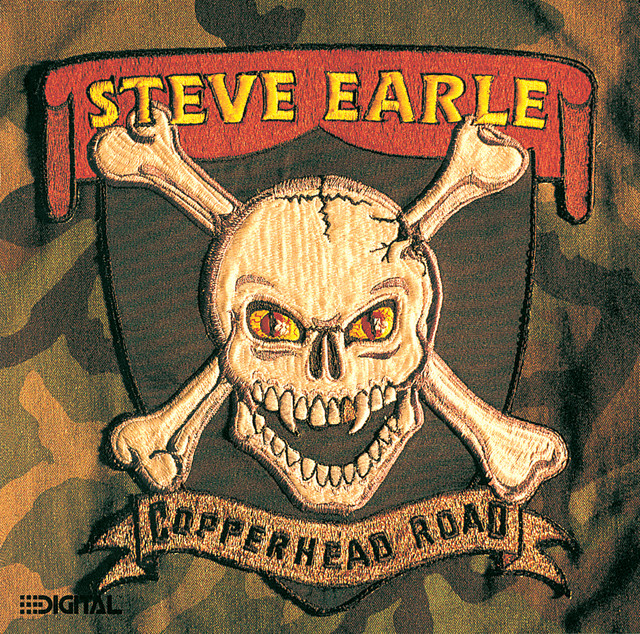
The production is not what Nashville was doing in 1988. MCA had signed Earle on the strength of Guitar Town two years earlier, a record that was spare and live-sounding and didn’t particularly care about the prevailing aesthetic. Copperhead Road pushed further — electric, dense, more rock than country, with pipes and drums on the title track that sound borrowed from the Pogues. Shane MacGowan’s band had been building that wall of Celtic noise for years, and Earle was paying attention.
It alienated a lot of country radio. Which may have been the point, or may just have been what happened when Earle wrote what the song needed instead of what a format would take. He’s never been someone who optimized for the room he was standing in. The record went gold anyway, on the back of people who found it without the radio’s help — and that audience, built show by show and word of mouth, turned out to be more durable than a format add would have been.
What the song actually is, underneath the outlaw mythology, is an argument about inheritance. Not the romantic kind — not the wandering-spirit, freedom-loving version of Appalachian culture that outsiders have been projecting onto the mountains for a hundred years. The real kind. The kind where you are born into a set of options, and you watch the men ahead of you work through those options, and you come back from a war the government sent you to with a new set of skills and the same set of options, and you make a decision.
The narrator isn’t celebrated. He isn’t condemned. He’s just there, doing what the people before him did, in a county that has been providing for itself outside official channels for as long as there have been official channels to work around. The pipes and the stomp of the drums aren’t ironic. They’re a funeral march and a declaration at the same time — this is what it sounds like when a tradition refuses to end.
If you ain’t done nothin’ wrong / if you ain’t had nothin’ to lose / stick around / this is Copperhead Road.
Country radio never came around, and it didn’t have to. The record went gold on the strength of people who found it without the radio’s help, an audience assembled show by show and by word of mouth, and that turned out to be the more durable arrangement: a following that belonged to Earle himself instead of to a format that could drop him the week the playlist changed.