No Rain
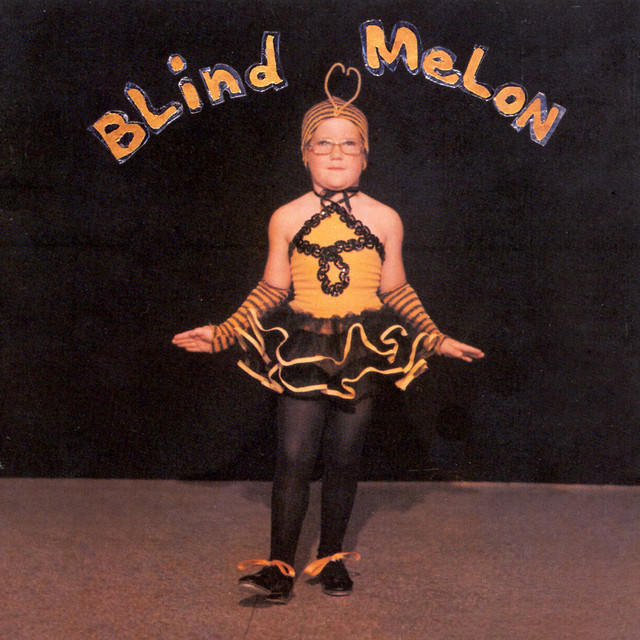
The bee girl was supposed to be in the video for thirty seconds.
The bee girl was supposed to be in the video for thirty seconds.
Director Samuel Bayer — who had just come off Nirvana’s “Smells Like Teen Spirit” — wanted her as a quick cutaway, a weird little grace note in a video that was mostly going to be performance footage of the band. Shannon Hoon talked him into making her the whole thing. The band disappears almost entirely. The bee girl gets every frame.
Her name is Heather DeLoach. She was ten years old. She answered a casting call, showed up in a yellow-and-black striped bodysuit with wings, and spent two days wandering around locations in the San Fernando Valley while the camera watched her look for somewhere she belonged. She finds a field full of beekeepers in the end. They’re all dressed like her. She runs to them.
That’s the whole story of the song, right there.
Shannon Hoon wrote “No Rain” in Baton Rouge before Blind Melon had a record deal. He was in his early twenties and he was already getting swallowed by the thing that would eventually kill him — the restlessness, the sense of being fundamentally out of place, the inability to feel like he was standing in the right life. He would be dead by twenty-eight, an overdose on the tour bus in New Orleans in October 1995, three years after the album came out and about two years into the band’s sudden, destabilizing success.
But the song was written before any of that. It was written in a kitchen or a bedroom in Louisiana by someone who was just trying to say what it felt like to be himself — slow and simple and slightly out of step with everyone around him. The music is practically a shrug. Brad Smith’s bass barely moves. Rogers Stevens’ guitar is clean and open, not trying to impress anyone. Christopher Thorn and Glen Graham are playing like they have nowhere to be. And Hoon’s voice sits right on top of all of it, confessional and unhurried, like he’s talking to one person who might understand.
All I can say is that my life is pretty plain.
That’s the first line. It doesn’t ask for anything. It doesn’t perform vulnerability or beg for sympathy. It just states a fact about a person — this is what my life is like, it doesn’t amount to much, and I’m not entirely sure how to want different. The whole song lives in that register. A person looking out a window at rain they can’t make stop.
The album came out in 1992 and “No Rain” didn’t really take until 1993, when MTV started rotating the video. What MTV was rotating was Heather DeLoach — ten years old in a bee costume, wandering through a world that found her ridiculous, not quite breaking down, not quite giving up. Kids who had absolutely no context for the band or the music understood her immediately. Adults who hadn’t felt seen in years understood her too.
The song peaked at number one on the Modern Rock chart that fall. Which was the same fall that Nirvana, Soundgarden, Pearl Jam, and Alice in Chains were rewriting what rock music was supposed to sound like — loud, angry, distorted, armored. “No Rain” went to number one without any of that equipment. It showed up at the party in a bee costume.
Hoon handled the success the way a lot of people handle getting what they asked for when they weren’t really ready: badly, and then briefly well, and then badly again. The band toured relentlessly. The follow-up album, Soup, was finished by mid-1995 and was strange and harder and didn’t find the same audience. He was back on the tour bus in New Orleans when his heart stopped. The bus driver found him the next morning.
What’s easy to miss — what gets swallowed by the video and the bee girl and the MTV nostalgia — is how well the song is built. There’s no chorus in the traditional sense, just a refrain that comes back and sits there:
I just want someone to say to me, I’ll always be there when you wake.
Not love, exactly. Not even connection. Just: someone in the room when morning comes. Someone who stays. The whole emotional ask of the song is that small and that enormous at the same time. It’s the loneliness underneath loneliness — not wanting grand passion, just wanting not to be alone in the morning. Hoon sang it into a microphone and it turned out several million people had been sitting with the exact same want and not quite had the words for it.
The bee girl finds her field at the end. She runs and they catch her and she belongs there, in a meadow full of beekeepers who all dressed like her. It’s a fantasy. That’s the point. The song doesn’t promise anyone a field. It just names the wanting.
Shannon Hoon was twenty-eight when he died. He’d been carrying that song for almost a decade — the hit, the video, the girl in the bee suit, the weight of having written the thing that would follow his name forever. He didn’t get to find out what he would’ve written at forty or sixty. What he left was a three-and-a-half-minute song about not fitting in, recorded plainly, with nowhere to hide.
He meant every word of it. That’s still the whole thing.