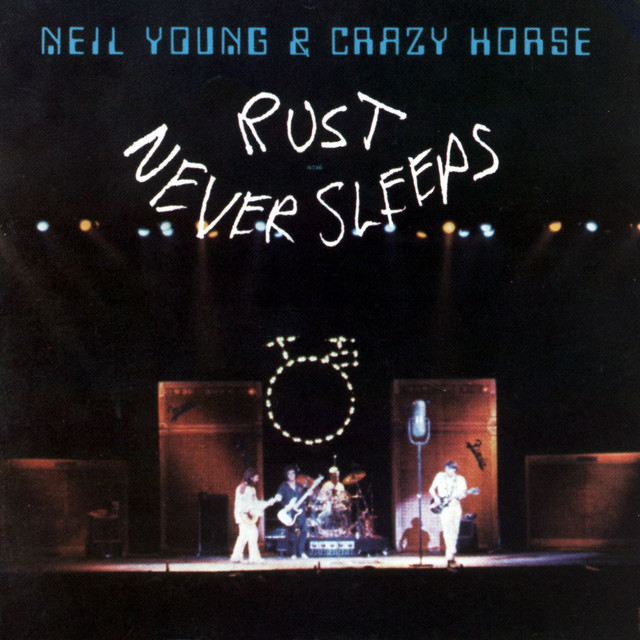
Hey Hey, My My
The song opens with a declaration that has no room in it for argument.
The song opens with a declaration that has no room in it for argument.
“Hey hey, my my — rock and roll can never die.”
Not shouldn’t. Not won’t. Can never. As in: the thing is constitutionally impossible. Neil Young puts that line in your mouth before you’ve had a chance to think about whether you believe it, and then he spends five minutes and twelve seconds making you wonder whether he does.
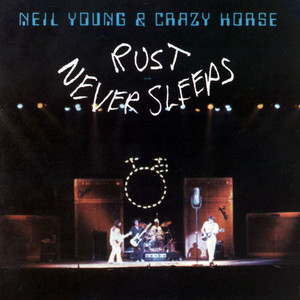
Rust Never Sleeps came out in 1979, and the whole record is a man in his mid-thirties watching something change and trying to name it. Punk had happened. Disco had happened. The generation that built the counterculture was either selling life insurance or in a farmhouse somewhere trying not to think about what happened to the counterculture. Neil Young was at the farmhouse. He’d watched it all, and he’d watched his contemporaries get careful, and careful was the thing that scared him most.
The song exists in two versions on the record — “My My, Hey Hey (Out of the Black)” opens it acoustic, and “Hey Hey, My My (Into the Black)” closes it electric with Crazy Horse, louder and more ragged and more serious about what it’s saying. Most people know the electric version. Most people should.
He names Johnny Rotten in it. That’s the fact that stops me.
Not metaphorically. “The king is gone but he’s not forgotten / this is the story of Johnny Rotten.” Neil Young, folk-rock survivor, crafter of pastoral guitar music about harvest moons and Ohio highways, wrote the name of the Sex Pistols’ lead singer into a song about the immortality of rock and roll. And he didn’t write it as dismissal or as tribute exactly — he wrote it as evidence. John Lydon had burned everything to the ground and walked away, and that act of destruction was proof the thing could still be burned. If it can still be burned, it’s still alive.
That argument is stranger than it sounds. Young is saying the health of the music isn’t measured by who’s standing — it’s measured by who’s willing to die for it. Not literally. But in career terms, in comfort terms. The dying he means is the dying of safety.
“It’s better to burn out than to fade away.”
That’s the line Kurt Cobain quoted in his suicide note, and the line became, briefly, a scandal — the argument being that Young had somehow handed Cobain a justification. Young has had to live with that interpretation for thirty years, and he has never pretended it was comfortable. The line was written about artistic compromise. It got used as something else. That’s the thing about a line strong enough to carry real weight: you can’t control where it gets set down.
Crazy Horse sounds like a building falling down in slow motion on this recording. Frank Sampedro on rhythm, Billy Talbot on bass, Ralph Molina on drums — not a band that’s going to impress you with precision. That’s never been the point. The point is that they sound like weather. They sound like something you can’t reason with. Young’s guitar cuts through the whole mess like he’s trying to split something open and see what’s inside, and what’s inside turns out to be more noise, and that’s the right answer.
The live performances of this song — and there have been decades of them — are almost always longer and louder and more violent than the record. Young will stand there and make sounds that are not comfortable and will not apologize for them. He is now pushing eighty. He’s still doing it. Whether or not that proves his thesis is a question worth sitting with.
The record is called Rust Never Sleeps. The argument of that title is the same argument as the song: oxidation doesn’t pause. The softening, the corrosion, the slow replacement of the original thing with something safer — it never stops working on you. The only answer is to keep moving. Stay hard. Stay in motion. The alternative isn’t rest. The alternative is the rust.
Johnny Rotten burned out. Neil Young kept moving. He put both of those facts in the same song and let them hold the same weight, because he understood that burning out and fading away are both real options and he was making a choice about which one he feared more.
He chose.
He’s still choosing.