Death of an Unpopular Poet
Nobody showed up to read the poems, so Buffett buried the poet himself.
Nobody showed up to read the poems, so Buffett buried the poet himself.
“Death of an Unpopular Poet” is ninety seconds shorter than “He Went to Paris” and sits four tracks away from it on the same album, and the two songs spend the whole record talking to each other without knowing it. Paris is about a man who lived enormously and lost accordingly. This one is about a man who lived quietly and lost accordingly. The math comes out the same.
The setup is plain: a poet dies. Nobody cared about his work while he was alive. Nobody cares that he’s gone. He leaves behind empty wine bottles, a handful of unread pages, and a landlord who wants the room back. That’s the whole story. Buffett tells it in three minutes and forty-one seconds and doesn’t reach for a single syllable more than it needs.
What he reaches for instead is the specific texture of the man’s failure. Not the romantic kind — not the misunderstood genius, not the artist martyred by a cruel world. This poet was just… unread. He wrote the poems. He showed up. Nobody came. The world went on not knowing or caring. Buffett understood at twenty-six that this is the more common version of a creative life, and he had the nerve to treat it as worthy of a song.
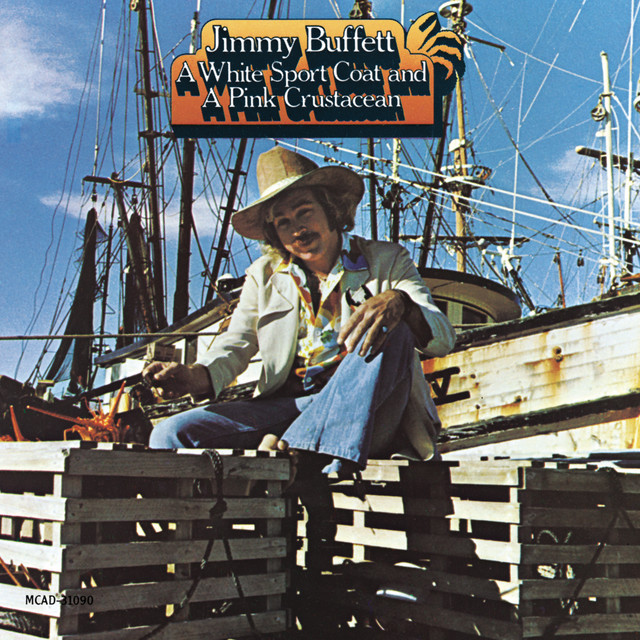
The album was A White Sport Coat and a Pink Crustacean, cut in Nashville in 1973 for ABC/Dunhill, Buffett’s first real crack at a label with distribution behind it. He was young and unknown and the songs he was writing didn’t fit anything on country radio at the time — they were too literary, too coastal, too interested in failure and old age and men who had run out of chances. Nashville didn’t know what to do with him yet, and he didn’t know what to do with Nashville, and the album has that friction in it, that slight looseness of a writer who hasn’t been told what he’s supposed to sound like.
That looseness is the record’s best quality. It let him write about an unpopular poet the same week he wrote about an eighty-six-year-old man in Paris, and not worry about whether either one would get played between the farm reports.
“He left behind some empty wine bottles and some folks he’d bored to death.”
Most obituaries avoid that kind of honesty. Most songs about dead artists turn them into saints the moment they’re gone — the suffering genius, the misunderstood prophet, the voice a cold world couldn’t hear. Buffett doesn’t do that here. He lets the poet be who he was: a man who wrote poems people didn’t want to read, who drank wine, who took up space in a rented room, who died as quietly and without ceremony as he had lived. And he makes that life matter, not by elevating it but by refusing to diminish it. The poem got written. The man got up every day and wrote the poem, even when nobody asked him to. There is something in that which deserves to be named.
The song ends without redemption. No one discovers his work in an attic. No one writes a tribute. The room gets cleaned out and rented to somebody else. It’s the version of the story that almost always actually happens, and Buffett ends it there without flinching.
He spent fifty years after this being famous for margaritas and flip-flops and “it’s five o’clock somewhere,” and that’s fair — he earned every bit of the Parrothead mythology, and he worked it honestly. But the evidence of A White Sport Coat and a Pink Crustacean is that he got famous with a record full of songs about men who didn’t get famous, and he understood those men, and he cared about them enough to get the details right.
The unpopular poet didn’t leave behind a catalog that anyone would mine for covers. He left behind empty bottles and some strangers’ mild annoyance. That’s the whole inheritance. Buffett put it on a record anyway — pressed it into vinyl, sent it out into the world — which is maybe the quietest act of respect on an album full of quiet acts of respect.
The poet was unpopular. The song about him was too, mostly. Neither of them quit anyway.