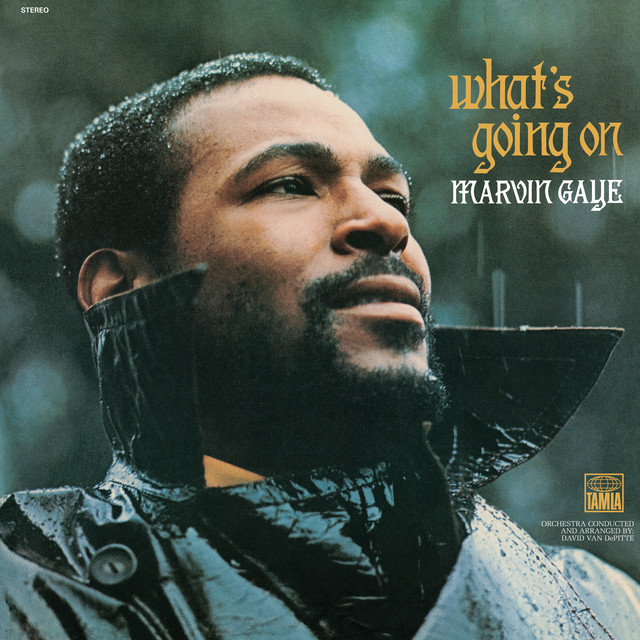
What's Going On
Motown rejected it.
Motown rejected it.
Berry Gordy told Marvin Gaye that What’s Going On was the worst record he’d ever heard. Not the worst record Marvin had made — the worst record. Gordy refused to release it. He had built Motown on a specific machine: tight, joyful, radio-ready, apolitical. Product, not testimony. And Marvin had handed him a seven-minute suite about police brutality and Vietnam and the smell of tear gas, built on a party tape from a gathering at Ric-Tic musician Elgie Stover’s place in Detroit, where people were talking and laughing over each other in the background — and Marvin had kept all of it in. The voices. The party. The noise of people just being alive.
Gordy said no. Marvin said he was done recording until it came out.
The standoff lasted a month. Gordy eventually relented — partly because the company needed the money, partly because he had heard by then that Marvin wasn’t bluffing. The single was released in January 1971 and sold 100,000 copies in its first week. Within a month, Gordy was calling it a masterpiece. The same record. The same noise. The same party tape underneath.
What Gaye had done — what made Gordy’s ears fail him on the first listen — was refuse the normal separation between a song and its world. Most soul records in 1970 were immaculate. The production cleaned away everything accidental. What Marvin wanted was the opposite: he wanted the record to sound like the world it was describing, which was a world that was not clean and not orderly and not working right.
He recorded multiple vocal parts and layered them, harmonizing with himself, letting the voices overlap and answer each other. He was doing what he always did when he sang at his best — not performing, but thinking out loud, working through something he hadn’t resolved. What’s going on is not a rhetorical question in his mouth. It sounds genuinely confused. Genuinely frightened.
Mother, mother, there’s too many of you crying.
He had a brother, Frankie, who had come back from Vietnam. Gaye listened to what Frankie described and he wrote it down the only way he knew how, which was through melody. There was no political program in the album, no manifesto. Just a man trying to understand what the country was doing to the people he knew.
Producer and arranger David Van De Pitte brought the strings. The jazz harmonies — those suspended, unresolved chords that made Gordy nervous — came from Marvin and pianist Joe Sample and the rhythm section of James Jamerson and Benny Benjamin. Jamerson’s bass line on the title track is one of the most praised pieces of playing in the history of the instrument: he reportedly played it lying flat on his back, half-drunk, in a single take, and when his son later asked him which hand did the work, Jamerson pointed to his right and said the god hand. That bass line is the ground the whole record walks on.
What’s Going On came out at the same time as everything else: the draft lottery, the killings at Kent State, Nixon and the news. The record didn’t cause anything, didn’t fix anything. But it did something quieter and maybe more durable. It said: I see this. I am not turning away. It said that in the most beautiful way Marvin Gaye knew how — which is to say, beautifully enough that you couldn’t dismiss it, couldn’t file it away as agitprop, couldn’t keep the music at arm’s length while you thought about the message. The music and the message were the same thing.
That’s what Gordy had missed. He was listening for the product. Marvin had sent him a person.
The album was recorded in six weeks. Marvin produced it himself, over Gordy’s objections, which was the only way it could have been made — because what it required was one person’s vision held all the way through, undiluted, from the party tape at the beginning to the medley at the end where all the themes come back and blur together like voices talking over each other. Like a city. Like a country in the middle of something it doesn’t understand.
He was thirty-one years old. He had been a Motown star for a decade, a hitmaker, a commodity. This was the first time he had made exactly the record he meant to make.
The party noise is still in there. People talking, glasses clinking, somebody laughing in the background. Gordy thought it sounded unprofessional. Marvin left it in because that’s what life sounds like — loud and unresolved, full of voices, going on and on whether anyone is ready or not.