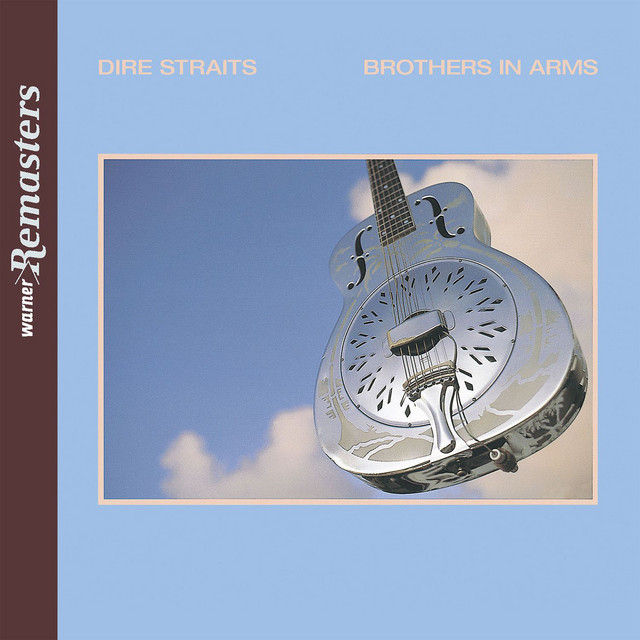
Brothers in Arms
The island where Dire Straits recorded this song was later half-buried by a volcano. The room went silent the way the song does — by fading.
The island where Dire Straits recorded “Brothers in Arms” was later half-buried by a volcanic eruption.
Montserrat. George Martin — the man who made Abbey Road sound the way it sounds — built AIR Studios there, carved into a hillside above the Caribbean. In 1984 the band set up in that room and recorded a song about two soldiers in a field at dusk, exhausted, still alive. The eruption ended the studio’s run entirely. The room is gone.
Mark Knopfler wrote the song during the Falklands War. Britain and Argentina were trading young men for a chain of South Atlantic islands most of the world couldn’t find on a map, and Knopfler wasn’t there — he was watching it on the news like everyone else. What he did with that distance is the part I keep thinking about. He didn’t write about the war. He wrote about two men in a field at dusk, exhausted, still alive, sitting inside the particular silence that follows violence. The abstraction on the television became concrete in the song. That’s the whole transaction, and it’s harder than it sounds.
“Through these fields of destruction, baptisms of fire, I’ve watched all your suffering as the battles raged higher.”
The melody underneath those words comes out of the British folk lament. Knopfler grew up in Newcastle absorbing American blues and country, and by 1985 he had folded all of it — the blues, the country, the moors and the rain and the old sad songs of the islands — into a single way of playing that you couldn’t take apart anymore. The guitar was how he spoke. On this song he speaks slowly.
The album was one of the first to be recorded, mixed, and released on compact disc, and Knopfler and producer Neil Dorfsman made it sound like it: wide, clean, the guitars sitting in the room with you, nothing softened the way tape would have softened it. People argued about whether that clarity was a virtue. Some still do. I’ll say this much — when the fingerpicking comes in on the title track, unhurried, played by a man with nothing left to prove, you hear every part of it. The recording refuses to blur what the song refuses to blur.
The band plays almost nothing. Guy Fletcher’s synthesizer pads hold the sky open. Alan Clark on keyboards. Terry Williams on drums, doing less than almost any drummer would agree to do — and that restraint is the song’s discipline, not its absence. Around the four-minute mark a guitar solo begins without announcing itself. No showboating, no moment where the musician reminds you he’s the musician. It answers the vocal melody, then answers itself, then answers the silence. If you’re not listening, it passes through you. If you are, it stays.
“We’re fools to make war on our brothers in arms.”
One line. Knopfler doesn’t explain it. He trusts you to already know.
The record sold twelve million copies. It sat at number one in the UK for a year, longer than anything had in decades. The band went out on a massive world tour, and then, essentially, dissolved. Knopfler went solo. The others scattered. Brothers in Arms turned out to be the last album Dire Straits made as a full working band — everyone in the room together, making something none of them could have made alone — and nobody in that room knew it at the time. Most things end without announcing they’re ending. You find out it was the last time after it’s over.
The song knew this before the band did. It doesn’t end. There’s no crescendo, no final chord rung out until it decays. The guitar just fades — something moving away from you down a long road, getting smaller, until it’s gone. Knopfler chose that. A song about men who don’t come home closes by leaving the room quietly, while you’re still listening for it.
And then, years later, the mountain finished it the way the song finishes — the hillside above the Caribbean going under ash, the room where Terry Williams held back and Knopfler spoke through his guitar falling silent for good, the whole studio receding the way that final guitar recedes, something moving away from you down a long road, getting smaller and smaller, until you’re still listening for it and it’s already gone.