While My Guitar Gently Weeps
Jeff Healey couldn't see the guitar, so he laid it flat on his lap and played it that way his whole life. You can hear it.
Jeff Healey couldn’t see the guitar, so he laid it flat across his knees and played it that way his whole life.
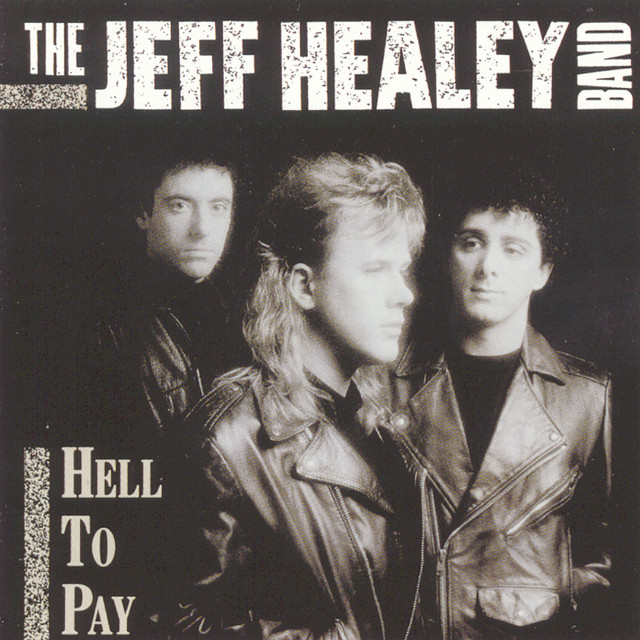
He was blind from retinoblastoma since before his first birthday. He was three years old when he started playing, and he held the instrument flat on his lap because that’s how a toddler reaches the strings, and because nobody told him there was another way. He kept doing it because it worked. In 1990, twenty-three years old, he recorded “While My Guitar Gently Weeps” for Hell to Pay, and it might be the best version anyone has done.
George Harrison wrote the original in 1968, loosely inspired by the I Ching — the idea that anything you pick up at random contains the universe. He opened a book to a random page and wrote around whatever he found there. What came out was one of the great laments in the Beatles catalog — I look at you all, see the love there that’s sleeping — but the White Album version had a stateliness to it. Eric Clapton played lead, brought in by Harrison because he thought Clapton’s presence would make the other Beatles behave. It worked. The song came out almost too well-mannered for its own heartbreak.
Healey wasn’t well-mannered. He was from Toronto, and by the time he got to Hell to Pay, his second album, he’d been in Road House with Patrick Swayze and toured with the Allman Brothers and B.B. King. He came to the song not as a cover artist paying tribute but as a blues player who’d been living inside this kind of sorrow his whole life.
The difference is in the first note.
Healey’s version opens darker, slower, the tempo pulling against itself like something doesn’t want to move forward. His voice comes in cracked at the edges, heavy, the sound of a man who has already been wherever this song is trying to go. Then the guitar answers him. Not as an ornament. As a second voice, mourning on his behalf when the words run out.
I look at the world and I notice it’s turning. Harrison wrote that as a cosmic observation. In Healey’s mouth it sounds like evidence — a man who looked hard at the world and found exactly what he expected, that it keeps going, indifferent, turning while everything that matters stays broken.
The solo opens up around the three-minute mark, and it’s the center of everything. It isn’t flashy. He could be flashy; he had the technique and the instincts. He chooses to be patient instead, stretching each note until it has said everything it has to say before letting the next one in. The blues isn’t about speed. It’s about duration. It’s about staying inside the feeling long enough to find what’s actually there.
Jeff Healey died in 2008. He was forty-one. The retinoblastoma that took his sight as a baby came back as cancer in his bones, and he was gone before most people outside of blues and guitar circles had absorbed what he was. He spent his final years playing traditional jazz, which was his first love — he’d been collecting jazz records since childhood, 78s, thousands of them, organizing a world he couldn’t see by sound alone. The blues-rock star was real, but it was never the whole picture.
That matters when you listen to this recording. There’s a depth to what he does with Harrison’s song that says he understood the original better than he let on — understood that Harrison was reaching for something about watching the people you love fail to reach each other, about the distance between what we feel and what we can say. Healey didn’t just cover it. He finished a sentence Harrison had started and left open.
The guitar weeps in both versions. In Healey’s, it weeps from a lap, from a man who never saw the strings, and it means every note.